Request support on coordination, information management, integration for nutrition outcomes or technical nutrition in emergencies assistance.
التماس الدعم لتنسيق التغذية وإدارة المعلومات والتغذية في حالات الطوارئ
Demander un appui pour la coordination de la nutrition, la gestion de l'information et la nutrition dans les situations d'urgence
Buscar apoyo para la coordinación de la nutrición, la gestión de la información y la nutrición en situaciones de emergencia
Solicite apoio para coordenação em nutrição, gestão de informação e nutrição em emergências

Ethiopia
L1Coordination mechanism: Cluster
Year of activation: 2000
DNCC: UNICEF NOC, TA
The Emergency Nutrition Coordination Unit (ENCU) is a Government unit supported by UNICEF and housed within the Ethiopian Disaster Risk Management Commission (EDRMC). It leads cluster coordination in addition to being the technical emergency nutrition arm of the Government of Ethiopia (GoE). As such, the ENCU leads and coordinates nutrition partners at federal, regional and district levels for a coherent, effective emergency nutrition preparedness and response to save lives and improve the nutritional status of vulnerable populations during emergencies. There are sub-national/Regional ENCU (RENCU) coordination staff (coordinators and IMO from government) in 7 regions of Ethiopia - Afar, Amhara, Central Ethiopia, Oromia, Somali, South Ethiopia and Tigray regions. UNICEF as a CLA, supports at subnational level the RENCU teams in the coordination functions.
The coordination mechanism is set-up through different technical working groups at national level including the SAG, CMAM TWG, IYCFE TWG, NIS TWG, Localization TWG and CVA for nutrition outcomes taskforce.
- ENSU Dashboard
Key Content
Highlights from Ethiopia
GNC July Newsletter
The July newsletter is out! Summer is starting to wind down, but our nutrition efforts never do. In this edition, we share news, team member spotlights, updated resources, and an Advocacy Focus country – where we share our response and the joint efforts w..
Read this news2025 Mid-Year Report
January to June 2025
The 2025 Humanitarian Needs Overview (HNO) have not yet been approved by the Ethiopian government.
The 2025 Humanitarian Needs Overview (HNO) have not yet been approved by the Ethiopian government.
Ethiopia is currently facing a complex and multifaceted humanitarian crisis, driven by a combination of conflict, recurrent droughts, floods, displacement, disease outbreaks, and economic challenges exacerbated by inflation. These factors have severely impacted food security, livelihoods, health, and nutrition particularly among children under five, pregnant and lactating women, and other vulnerable groups.
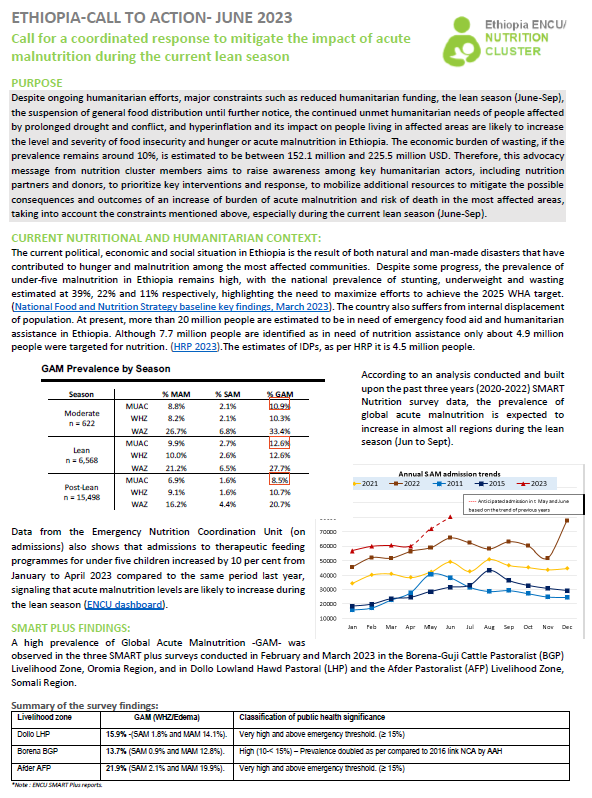
The severity of acute malnutrition is widespread across the country. A Rapid Nutrition Assessment (RNA) conducted in various woredas of the Amhara region revealed a proxy Global Acute Malnutrition (GAM) rate exceeding 15%, which is classified as critical. Therapeutic Feeding Programme (TFP) admissions also indicate high caseloads, with Oromia, Amhara, Tigray and Somali regions reporting significant increases in Severe Acute Malnutrition (SAM) cases among children under five in the past two months.
Over the past six months, three SMART+ surveys were conducted in the Korahay Agro-Pastoral (KAP) livelihood zone of Somali, the Gurage-Siltie Highland Enset and Barley (GEB) livelihood zone of Central Ethiopia, and Hamabela Wamana woreda in Oromia. The findings revealed a very high prevalence of Global Acute Malnutrition (GAM) (>15%) in Somali, high levels in Hamabela Wamana, and normal levels in the GEB zone. However, due to insecurity and limited access, only a few surveys have been conducted in 2025, and many of the most conflict-affected areas were not assessed. Despite this gap, TFP admission trends continue to highlight the critical nature of the malnutrition situation across the country.
Funding constraints have further exacerbated the crisis. A freeze in U.S. government funding and cuts from other donors have led to severe shortages of therapeutic and supplementary foods, including Ready-to-Use Therapeutic Food (RUTF), therapeutic milks, and TSFP supplies. In response, the Ethiopian Ministry of Health introduced a modified RUTF dosage protocol in May 2025, providing two sachets per child regardless of weight, to stretch limited supplies. Despite efforts by UNICEF and implementing partners to procure and distribute therapeutic milk, a nearly two-month pipeline break has made it extremely difficult to treat SAM cases with complications in stabilization centers. The supply remains insufficient to meet the growing needs.
In summary, overall country-wide, from January to June 2025:
- A total of 329,664 children with Severe Acute Malnutrition (SAM) have been admitted to the Therapeutic Feeding Program (TFP), representing 46% of the annual Humanitarian Response Plan (HRP) target for SAM case management
- In addition, approximately 762,328 children with Moderate Acute Malnutrition (MAM) and 296,343 pregnant and lactating women (PLW) with acute malnutrition have been reached through the Targeted Supplementary Feeding Program (TSFP).
https://app.powerbi.com/view?r=eyJrIjoiNjZlMmI3ODctMzVkZi00MWRjLTkwMmUt…
The response that was provided by the nutrition cluster members was partially aligned with the needs and objectives, but faced several challenges and constraints, such as:
- Inadequate funding has significantly limited both the scale and quality of the nutrition response, including the procurement and distribution of essential supplies. As a result, areas with high rates of malnutrition and urgent humanitarian needs have been left behind, further exacerbating the vulnerability of affected populations.
- Since March 2025, there has been a critical pipeline break in the supply of Therapeutic Feeding Program (TFP) and Targeted Supplementary Feeding Program (TSFP) commodities. In response to the constrained supply, the Ministry of Health (MoH) has endorsed an interim modified dosage protocol, providing two sachets of Ready-to-Use Therapeutic Food (RUTF) per child regardless of weight, to extend the availability of existing stock.
- However, even with the reduced dosage, current supplies are projected to last only until the end of September 2025. This shortfall is expected to further worsen an already critical nutrition situation, putting vulnerable children at even greater risk.
- Health and nutrition services in many conflict-affected areas, particularly in districts under the control of armed groups, have been severely disrupted. Health workers have fled these areas, some health facilities have been damaged or destroyed, and in other locations, services are not being delivered due to critical shortages of medical and nutrition supplies. This situation puts the lives of children and other vulnerable groups at serious risk.
- In some areas, health workers are not receiving their monthly salaries and overtime payments regularly. As a result, many are unwilling to work overnight shifts at Stabilization Centers (SCs), which require continuous 24/7 service to effectively manage and treat children with severe acute malnutrition plus medical complication.
- Insecurity and access restrictions hampered the delivery and monitoring of nutrition services, especially in conflict-affected areas.
- Acute malnutrition prevention efforts in a humanitarian context are not enough.
- Due to funding constraints, the Nutrition Cluster has been operating its coordination efforts with only one staff member, which significantly hampers the effectiveness of coordination activities.
The Cluster has been actively promoting and implementing an inter-cluster, sectoral collaboration approach involving five key clusters: Health, Nutrition, Agriculture, Food, and WASH, with NGOs serving as implementing partners across most parts of the country. This coordinated effort is driven by a shared goal, reducing the burden of malnutrition and mortality. As part of this initiative, a Call to Action has been developed. Additionally, the Nutrition Cluster has been advocating for donor support to fund multisectoral responses, aiming to achieve more effective and sustainable nutrition outcomes.
- In the link of documents
Key Figures
(million)Funding
(million)- Children 6-59 months
- Pregnant and lactating women
70
Total Partners
Nutrition Cluster Key resources
list of important documents
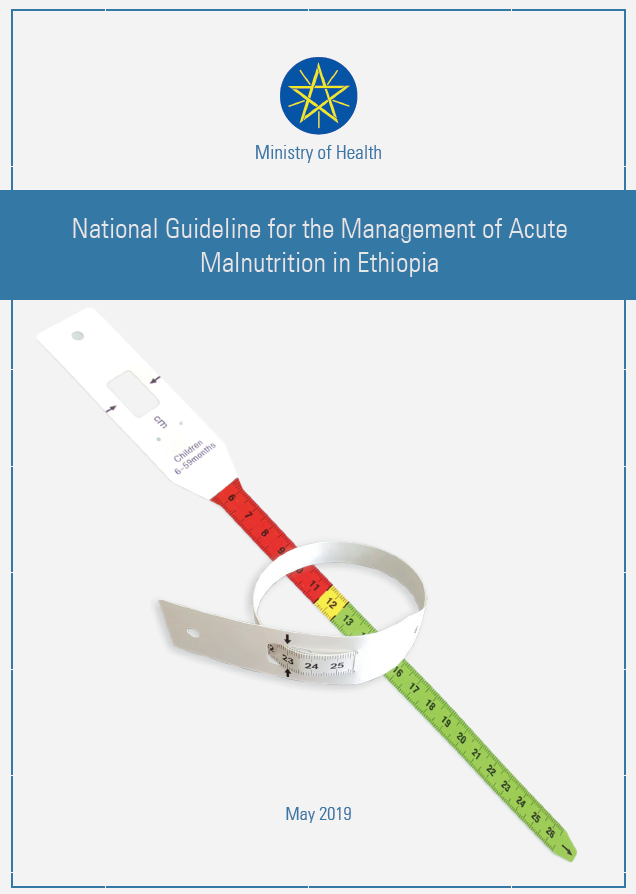
Ethiopia National Guideline for Management of Acute Malnutrition May 2019
The Federal Ministry of Health (FMOH) developed the first Protocol for the Management of Severe Acute Malnutrition (SAM) in 2007, and the Guideline for the Management of Moderate Acute Malnutrition (MAM) in 2012. This National Guideline for the Management of Acute Malnutrition in Ethiopia replaces...